
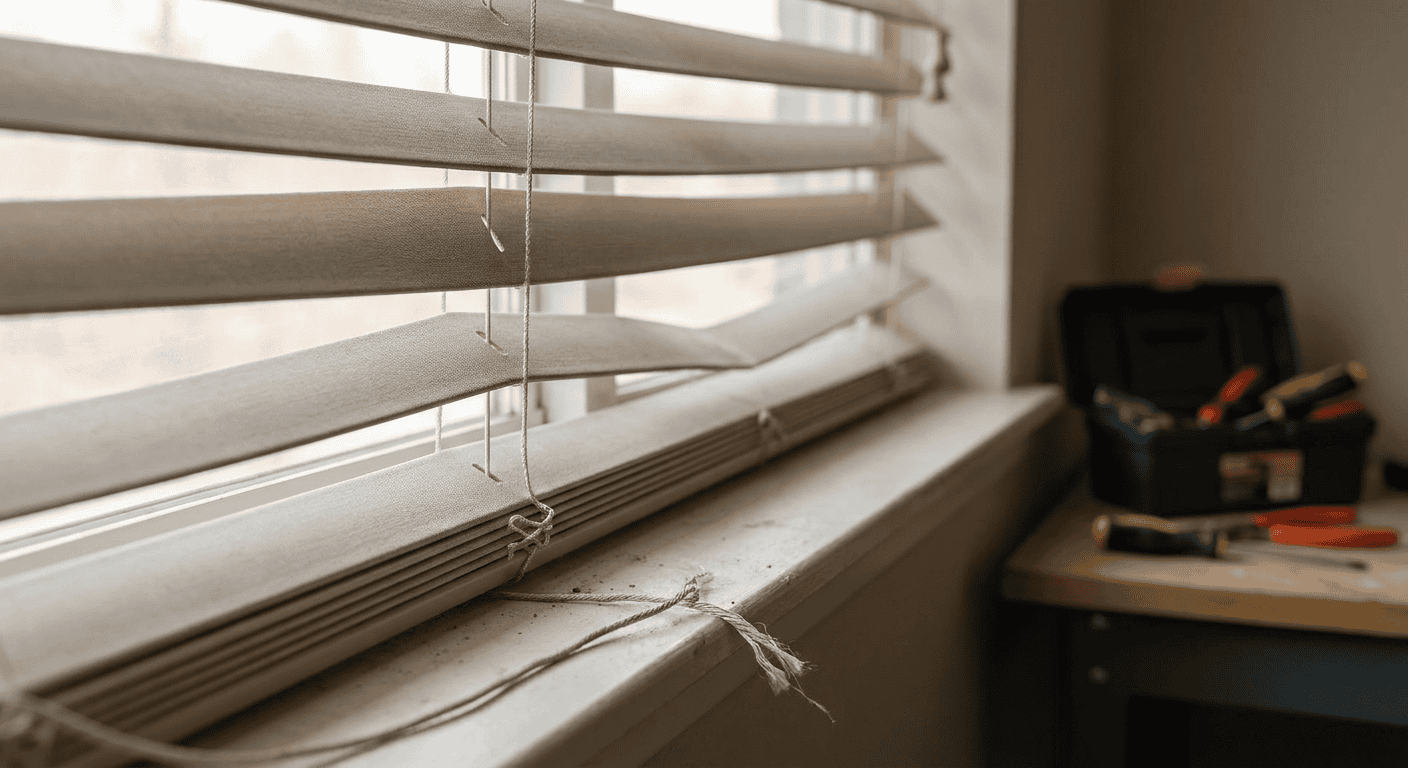
While quick DIY adjustments can resolve minor jams, complex issues like stripped tilt mechanisms, snapped internal cords, or motor malfunctions require professional window blind repair to prevent further structural damage. Professional repair services can ensure proper operation and may be more cost-effective than replacement, especially for complex systems.. Professional services often have access to OEM parts for brand-specific mechanisms, ensuring proper function and safety.
Overview
Mechanical assemblies inside window treatments eventually wear out from daily operation, cord friction, and sun exposure. Evaluating whether to tackle window blind repair independently or hire a specialist depends on internal component damage, ladder access constraints, and part availability.
The following sections outline diagnosis steps, labor comparisons, and service criteria, including a labeled real-world hypothetical that illustrates an on-site restoration decision.
- Mechanical Failures: Identify internal gear slippage, ladder string tears, and common blind issues that disrupt daily operation.
- Labor Assessment: Compare simple slat swaps against technical restringing to decide between quick fixes and professional repair options.
- Critical Warning Signs: Review jammed headrails, tilt mechanism locks, and clear indicators of damage requiring workshop intervention.
- Provider Criteria: Check warranty coverage, component sourcing, and key standards when evaluating local technicians.
- Restoration Process: Learn how specialized bench tools and replacement hardware allow precision restoration work on complex assemblies.
- Investment Advantages: Review color matching, extended shade lifespan, and the direct advantages of professional service over total replacement.
Troubleshooting Frequent Failures in Window Blind Components
Mechanical strain and daily wear frequently degrade hardware, leaving homeowners unable to balance daylight or maintain indoor privacy. Selecting high-grade Hunter Douglas® blinds helps minimize component wear, yet prolonged ultraviolet radiation and heavy handling still produce mechanical failures over time. We evaluate the core assemblies inside the headrail to pinpoint why shades bind, tilt unevenly, or refuse to hold position.
| Blind Failure | Primary Mechanical Cause | Correction Method |
|---|---|---|
| Cracked or Snapped Louvers | Ultraviolet brittleness, direct impacts, or excessive bending tension. | Individual louver extraction and genuine manufacturer replacement. |
| Shredded Lift Lines | Repetitive abrasion across metal eyelets or degraded fiber cores. | Full assembly restringing through the inner routing channels. |
| Unresponsive Tilter Control | Stripped planetary gears, disconnected wand stems, or housing debris. | Headrail gear module disassembly or unit replacement. |
| Immobilized Cord Lock | Jammed gravity rollers, twisted line guides, or trapped headrail grit. | Dog-lock realigning, guide clearing, and spring tension calibration. |
Homeowners often attempt forceful pulls when cords catch, which frequently strips delicate tooth assemblies inside the top rail. While learning how to safely clean blinds removes surface grime, internal mechanical snags demand specialized diagnostic tools to prevent bending the metal housings. DM Interiors corrects these hardware breakdowns rapidly, substituting genuine factory components so your window coverings operate as smoothly as day one.
Deciding Between DIY Maintenance and Professional Service
Homeowners often weigh the convenience of a quick home fix against hiring a technician when window coverings malfunction. Simple mechanical glitches like an untangled control string or a loose mounting clip take only minutes to secure with basic hand tools. However, tackling internal gear mechanisms or electronic assemblies without factory training frequently turns a minor hitch into permanent damage.
Wood and faux wood blinds often require structural teardowns when multiple slats split or internal ladder strings snap. While swapping a single slat on basic horizontal shades remains manageable at home, opening the metal casing invites trouble. Forcing open a stuck tilt gear or pulling misaligned components can bend structural housings past the point of recovery.
| Repair Scope | Recommended Approach | Typical Requirements |
|---|---|---|
| Surface adjustments and single-slat swaps | Home maintenance | Standard screwdrivers, replacement clips, matching slats |
| Internal tilt gears and stripped drums | Professional service | Specialized disassembly tools, factory-matched mechanical components |
| Automated motors and custom valances | Professional service | Diagnostic equipment, proprietary manufacturer hardware |
High-end automated systems and custom builds incorporate proprietary components from manufacturers like Hunter Douglas®. When managing specialty motorized gear or integrated window treatments, homeowners face intricate wiring, delicate circuit boards, and tensioned springs that resist standard garage tools. DM Interiors suggests inspecting the precise source of failure first; if the breakdown hides inside the upper casing or involves electronic controls, scheduling a certified repair preserves the product warranty and avoids an expensive full replacement.
Fixing Broken Slats Versus Replacing Treatments
Custom window treatments represent a major home investment, making the choice between targeted restoration and total replacement a financial priority when components fail. Homeowners facing snapped louvers or tangled string ladders can evaluate whether spot service restores balance or if aged materials warrant an upgrade.
When Component Restoration Beats Full Replacement
Take Eleanor, a homeowner dealing with worn mechanisms in her main gathering area. Her wood and faux wood blinds show fraying on one lift cord and two split horizontal louvers from years of regular sun exposure. Purchasing brand-new fixtures would strain her monthly budget, yet letting damaged slats hang unevenly ruins the room presentation.
- Isolated slat damage: Technicians slide out cracked wood or composite pieces, sliding matching profiles into the ladder tapes without removing headrails.
- Frayed string cords: Complete restringing restores smooth raising and lowering before an internal cord snaps completely.
- Cost efficiency: Targeted mechanical repairs average a fraction of full unit replacement costs, preserving the existing color match across adjacent windows.
For problems confined to localized parts, DM Interiors recommends selective restoration. Swapping out worn cords and cracked slats restores full mechanical operation while preserving your original window casings for years ahead.
Vetting the Right Window Blind Repair Specialist
Custom window treatments protect your indoor privacy and light balance, so hiring a qualified technician prevents accidental structural harm during mechanical service. At DM Interiors, we advise clients to verify that a contractor has verified history with horizontal, vertical, and specialty configurations before handing over any hardware.
Key Criteria for Selecting a Blind Technician
- Material and System Expertise: Servicing premium wood and faux wood blinds involves exact tension balancing and slat alignment that general handymen rarely master. Ensure your technician demonstrates hands-on familiarity with your exact brand and gear setup.
- OEM Component Sourcing: Top-tier residential blinds depend on precision internal drums, tilt gears, and lift spools. Ask directly if the workshop stocks original manufacturer replacements rather than generic substitute hardware that can fail prematurely.
- Transparent Written Quotes: Trustworthy operations provide itemized estimates separating bench fees, on-site labor, and replacement parts so you can compare the restoration price against total replacement.
Professional Window Blind Restoration at DM Interiors
Investing in skilled maintenance for your window coverings preserves custom installations while avoiding the steep expense of total replacement. DM Interiors repairs modern and vintage systems alike, preserving your existing decorating schemes without forcing unplanned interior renovations. Extending the lifespan of hardware protects your budget while maintaining smooth daily operation across every room.
Restoration projects follow a clear, two-step evaluation structure to deliver durable results:
- Physical inspection: We examine mechanical components, fabric tension, and slat integrity to establish overall viability and map out necessary mechanical corrections.
- Component acquisition: Hardware failures require matching parts, so we obtain precise factory-grade gearboxes, lift cords, tilt wands, and carriers suited to specific manufacturers.
Tackling large patio door assemblies like Hunter Douglas vertical blinds often involves track realignment or vane clip replacements that restore effortless glide. Horizontal layouts such as modern metal blinds frequently require ladder string restringing, clutch servicing, or bent slat corrections. Our targeted repairs return stubborn hardware to peak working order quickly.
Advantages of Professional Window Treatment Restoration
Investing in professional window blind repair preserves your original investment at a fraction of the cost of total replacement. Over time, heavy daily operation strains internal tilt gears, frays lift cords, and snaps internal ladders. Rather than discarding premium shades, skilled technicians replace damaged assemblies with precision parts to ensure smooth, dependable operation for years.
Sourcing exact factory hardware presents a significant hurdle for homeowners attempting self-repairs. Premium brands, including custom Hunter Douglas® blinds, rely on proprietary components and specialized tensioning equipment that generic hardware store kits cannot match. DM Interiors maintains direct inventory channels to supply genuine parts, ensuring every gear, wand control, and motorized housing aligns with original factory specifications.
| Repair Objective | Service Approach | Practical Benefit |
|---|---|---|
| Prolonged Hardware Lifespan | Complete mechanical tune-up and re-stringing | Restores fluid movement without putting stress on neighboring window components. |
| Manufacturer Alignment | Genuine factory hardware integration | Preserves system warranties and structural integrity across custom shades and blinds. |
| Diagnostic Accuracy | Root-cause mechanical analysis | Eliminates recurring cord jams, slat drops, and uneven lifting once and for all. |
Trusting experienced technicians removes the guesswork and risk of accidental slat damage during teardown. We handle every step of the restoration process, returning balanced, flawless window treatments to your living spaces quickly and reliably.
Technical Review & Local Standards
Product specifications, mounting clearances, and technical details in this guide on Window Blind Repair Costs And When To Hire A Professional are verified against official manufacturer technical reference manuals and field-tested across residential installations in Marietta, Ellijay, Dacula, and surrounding metro Atlanta communities.
Recommendations for light control, privacy, and year-round comfort reflect real-world performance in Georgia homes across humid summers and varied residential installs. Written and reviewed by the certified window covering specialists at The DM Interiors Team. Last reviewed: November 2026.
FAQ
To help you decide the best approach for fixing your damaged treatments, the guide below answers common questions about window blind repair, typical service costs, and when it is safest to hire an expert.
| Question | Answer |
|---|---|
| How much does professional window blind repair typically cost in Marietta, Georgia? | Professional repair rates in Marietta, Georgia generally range from $50 to $175 per window, depending on the blind mechanism and the damaged components. Minor restringing jobs sit at the lower end of that range, while complex internal gear replacements or motorized tilt adjustments cost more. If the total repair estimate exceeds half the price of a custom replacement, buying new window coverings is usually the smarter financial move. |
| Can motorized or smart blinds be serviced instead of replaced? | Yes, many motorized blind failures stem from dead remote receivers, depleted battery packs, or misaligned drive gears rather than a fully burned-out motor. A certified technician can test the low-voltage electronics, recalibrate the lift limits, and replace discrete internal components. If the proprietary motor casing or internal wiring harness is completely shorted out, replacing the entire headrail assembly becomes necessary. |
| Which blind problems pose hidden safety risks if fixed without professional help? | Broken internal spring tensioners in cordless blinds and frayed continuous-loop cords present genuine safety risks. Cordless mechanisms store high mechanical tension inside the headrail that can snap violently during disassembly. Improperly re-strung cords also fail to meet current child and pet safety regulations, making expert repair the safer option for family homes. |
| Should warped faux wood slats be straightened or fully swapped out? | Warped or heat-damaged faux wood slats cannot be flattened back into shape and require individual slat replacement. Technicians match the route hole spacing, slat width, and color profile from manufacturer-specific stock to rebuild the blind ladder. If intense Georgia summer sun has warped more than four or five slats throughout the blind, replacing the entire treatment delivers better long-term durability. |