
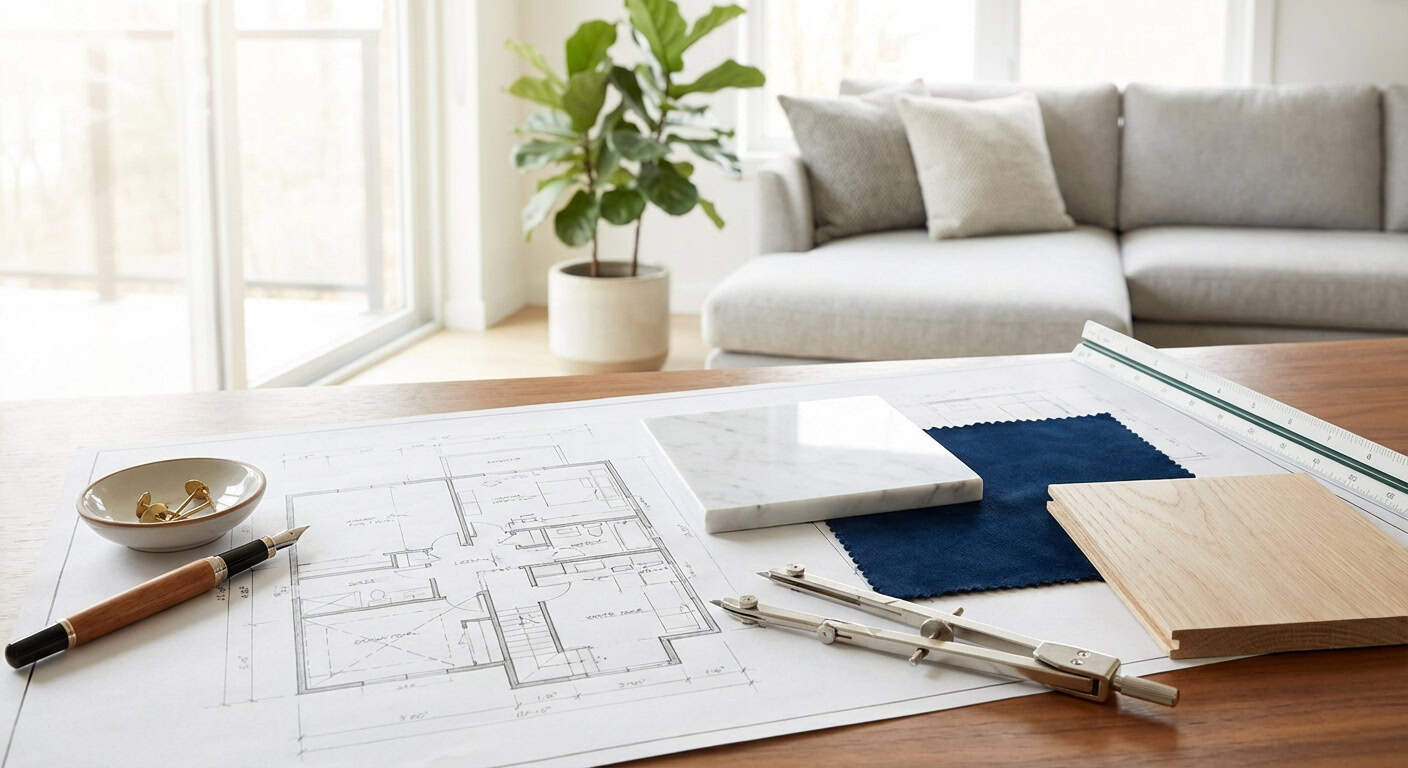
Working with professional custom interior designers allows homeowners to transform ordinary layouts into bespoke environments tailored specifically to their daily routines and aesthetic goals. At DM Interiors, our team conceptualizes every architectural detail, finish, and furnishing, offering tailored solutions like living room interior design to elevate core gathering spaces. Through meticulous space planning and personalized material curation, we eliminate guesswork to build inviting homes that stand the test of time.
Overview
Planning a whole-home renovation or room refresh involves coordinating layout adjustments, sourcing bespoke materials, and establishing realistic budget guardrails. Property owners evaluating custom interior designers frequently ask questions such as “how do design fees break down?”, “what happens during initial site consultations?”, and “how does bespoke sourcing prevent costly purchasing errors?”
The following sections outline hiring criteria, structured workflows, pricing tiers, and trade-only resource access. This guide also reviews a labeled real-world hypothetical to illustrate how a personalized scope addresses specific layout constraints before project kickoff.
- Designer Selection: Review credentials, portfolio range, and contract clarity before you hire a designer.
- Budget Planning: Clarify procurement markups, hourly consultations, and overall project pricing structures.
- Workflow Steps: Study the site survey, space planning, and trades coordination included in the custom design process.
- Real-World Example: A labeled residential case study illustrates how personalized finishes achieve a space transformation.
- Project Tradeoffs: Weigh retail furniture delays and retail sizing errors against professional support when evaluating trade sourcing advantages.
- Consultation Next Steps: Schedule an on-site evaluation to start a consultation.
How to Choose the Right Custom Interior Designer
Professional design services shape every phase of a residential remodel, determining how smoothly construction runs and how practical the finished rooms feel. Hiring the right studio protects your budget from expensive rework while guaranteeing that your daily habits guide every floor plan decision. Homeowners should assess how potential partners structure planning meetings, manage contractor timelines, and capture client expectations.
DM Interiors grounds every residential assignment in direct homeowner dialogue. We begin each project with detailed consultations to map out functional priorities, storage demands, and finish preferences before specifying single items. Transparent progress reports keep everyone aligned, preventing scheduling friction, order discrepancies, and sudden scope adjustments during installation.
| Core Hiring Criteria | Direct Project Benefit |
|---|---|
| Structured Communication | Eliminates installation mistakes by validating technical specs and schedules early. |
| Documented Portfolio | Demonstrates craftsmanship, spatial versatility, and real finish execution across past homes. |
| Lifestyle Alignment | Ensures millwork, circulation pathways, and furnishing choices match your household routines. |
Reviewing our before and after project gallery provides a clear view of our craftsmanship across varied residential layouts. Comparing real project transformations helps you evaluate finish quality, space planning precision, and lighting strategies before committing to a design agreement.
Cost Structures and Budget Planning for Interior Design
Establishing realistic spending caps upfront establishes the boundaries for finishes, square footage modifications, and trade labor. Total investments vary depending on practitioner background, structural complexity, and the billing structure selected for the job. At DM Interiors, we map out transparent fiscal parameters during preliminary consultations so clients maintain financial control throughout every phase of construction or styling.
Client involvement choices direct the bottom line. Full architectural renovations demand extensive site management, permit acquisitions, and mechanical coordination. Conversely, decorative updates focus resources on lighting, furnishings, and custom textiles. For instance, incorporating specialized window treatments requires precise fabric calculations and installation allowances rather than contractor demolition fees.
Total invoices combine distinct cost centers, including initial design sessions, technical drafting, trade-only purchasing, and contractor supervision. Clear line items protect homeowners from surprise expenses as work progresses. Similar principles apply whether managing a residential master suite or investing in corporate spaces through commercial interior design programs.
| Fee Structure | Best Application | Primary Cost Drivers |
|---|---|---|
| Hourly Rate | Focused design advice, color consultations, or small room refreshes | Billable hours accumulated during meetings, sourcing, and site reviews |
| Flat Project Fee | Complete space overhauls with firmly established architectural scopes | Square footage, complexity of custom millwork, and overall labor duration |
| Cost-Plus Percentage | Full-scale renovations incorporating extensive retail and trade furnishings | Net procurement expenses for furniture, fixtures, and freight handling |
When planning dedicated workspaces, our tailored office interior design frameworks help business owners balance ergonomic requirements against durable commercial materials without exceeding capitalization goals.
Why Hire Custom Interior Designers for Your Renovation
Investing in tailored design services gives homeowners an alternative to repetitive catalog furnishings and generic showroom packages. Property owners regularly encounter layout limitations, odd architectural angles, or specific daily routines that off-the-shelf furniture and basic decorating packages fail to resolve.
Consider a client like Eleanor, who aims to redesign her primary residence to match her specific lifestyle and creative tastes. While evaluating whether specialized custom interior designers justify the expense over standard retail decorators, she weighs the long-term value of bespoke millwork, curated materials, and architectural coordination against the cost of basic styling assistance.
Tangible Benefits of Dedicated Custom Planning
Engaging a dedicated specialist becomes the right path whenever original, uncompromised styling and exact architectural proportions take precedence. DM Interiors builds custom environments around exact spatial requirements, offering clear advantages over conventional decorating:
- Tailored room layouts engineered around personal traffic patterns, natural lighting, and architectural focal points.
- Direct sourcing of durable textiles, artisan finishes, and trade-exclusive furnishings unavailable through standard retail stores.
- Precise coordination for complex zones through specialized kitchen interior design planning that balances custom cabinetry dimensions with daily culinary use.
- Integrated storage solutions fabricated to maximize room dimensions without visual clutter.
Securing an experienced professional interior designer guarantees that every millwork detail, finish selection, and spatial adjustment directly serves the homeowner’s long-term functional goals.
Enhancing Daily Life Through Tailored Spaces
Design services convert standard residential structures into intentional environments built around your household habits. DM Interiors configures residential floor plans around daylight exposure, traffic patterns, and existing architectural elements so every room operates smoothly throughout the day.
Intentional interior plans balance visual balance with real utility. Our specialists structure rooms around two primary performance goals:
- Physical Ease: Strategic furniture groupings and cohesive color palettes remove visual friction, turning hectic gathering spots into calm retreats.
- Targeted Efficiency: A bespoke living room interior design plan establishes clear walkways, eliminates dead zones, and reserves square footage for your family routines.
Custom room development gives homeowners spaces tailored precisely to daily habits rather than builder-grade compromises.
Professional Interior Guidance or Independent Renovation
Full-service design services deliver spatial planning precision, color theory balance, and vendor access that independent home makeovers struggle to replicate. Property owners weigh available hours, target budgets, and expected quality when choosing between self-managed updates and hiring custom interior designers. While handling renovations independently eliminates professional labor expenses and grants immediate autonomy, pulling together disparate fabrics, architectural profiles, and layouts without professional training frequently causes visual disjointedness.
Coordinating finishes demands technical experience that goes well beyond surface styling. We witness clients underestimate the scheduling complexity and physical effort required to align flooring, bespoke woodwork, wall coverings, and lighting temperatures across contiguous rooms. Custom interior designers anticipate structural, electrical, and measurement errors prior to ordering, preventing costly replacement cycles while securing trade-only textiles, furnishings, and bespoke millwork unavailable through public retail channels.
| Project Attribute | Independent Renovation | Custom Interior Designer |
|---|---|---|
| Resource Access | Consumer showrooms and retail inventories | To-the-trade fabric houses, private workshops, and specialty artisans |
| Layout & Scale | Trial-and-error placement | Architectural spatial mapping and exact proportion modeling |
| Risk Exposure | Self-funded mismeasurements and contractor coordination delays | Detailed project management with pre-construction problem prevention |
| Style Balance | Frequent over-saturation of trends | Calculated execution of foundational motifs and curated accents |
Interior composition frequently relies on the classic 80/20 balance rule, where 80 percent of a room reflects a dominant foundational aesthetic and the remaining 20 percent incorporates unexpected accents, contrasting textures, or bold artwork. Novice decorators regularly miscalculate these ratios, producing spaces that feel either completely sterile or chaotic. Choosing tailored custom window treatments alongside structured architectural details ensures that primary surfaces establish continuity before smaller decorative elements enter the space.
Property scale and scope dictate the most effective path forward:
- Independent updates work best for: Refreshing decorative accessories, swapping accent pillows, repainting an isolated powder room, or rearranging lightweight freestanding furniture.
- Professional collaboration proves superior for: Removing structural partitions, executing floor-to-ceiling kitchen reconfigurations, designing integrated cabinetry, or requiring one-of-a-kind bespoke upholstery for high-traffic gathering areas.
Custom Interior Design Services with DM Interiors
DM Interiors specializes in bespoke residential and commercial styling that balances homeowner individuality with daily utility. Every blueprint begins by listening to your functional priorities, translating distinct lifestyle habits into tailored floor plans, material selections, and finishes. We coordinate each phase from schematic concepts through final placement, maintaining active communication and precise staging schedules to prevent surprises.
Tailored appointments produce environments that stay comfortable and functional for years. To help determine the appropriate project scope, consider the following roadmap:
| Project Scope | Recommended Approach | Budget Profile | Core Advantage |
|---|---|---|---|
| Full Home Redesign | Whole-house conceptualization and space planning | Higher initial capital, maximum durable value | Guarantees unified architectural flow and consistent materiality across every room. |
| Targeted Area Refresh | Focused renovations such as dedicated kitchen interior design or living suite overhauls | Mid-tier investment, immediate functional gain | Modernizes high-traffic gathering zones without the downtime of whole-property construction. |
| Commercial Buildouts | Workplace planning for corporate and retail offices | Flexible pricing aligned with square footage | Builds a welcoming atmosphere that strengthens brand credibility and supports workplace productivity. |
| Bespoke Accents | Handcrafted custom window treatments and upholstery | Moderate expense, strong visual impact | Delivers precise light filtering, sound dampening, thermal efficiency, and tailored styling. |
Technical Review & Local Standards
Product specifications, mounting clearances, and technical details in this guide on How Custom Interior Designers Plan And Manage Home Projects are verified against official manufacturer technical reference manuals and field-tested across residential installations in Marietta, Ellijay, Dacula, and surrounding metro Atlanta communities.
Recommendations for light control, privacy, and year-round comfort reflect real-world performance in Georgia homes across humid summers and varied residential installs. Written and reviewed by the certified window covering specialists at The DM Interiors Team. Last reviewed: November 2026.
FAQ
Bringing a personalized vision for your home to life often involves important decisions around timing, investment, and collaboration. Review the table below for answers to common questions about partnering with custom interior designers to transform your space.
| Question | Answer |
|---|---|
| How do custom interior designers differ from traditional home decorators? | Decorators focus primarily on surface aesthetics such as paint colors, textiles, and furniture arrangements. Custom interior designers alter spatial layouts, collaborate with builders on structural changes, and draft custom millwork to reconfigure the architecture of living spaces. If a renovation requires moving interior walls or reworking electrical placements, hiring a designer rather than a decorator ensures proper structural planning. |
| What should homeowners in Marietta, Georgia expect to invest in design fees? | Professional design fees in Marietta, Georgia generally range from $100 to $250 per hour, though many professionals use flat-fee structures or cost-plus procurement models for larger projects. Total investment depends on square footage, architectural complexity, and custom trade finishes. Procured furnishings, custom drapery, and construction labor are billed separately from conceptual and drafting fees. |
| Can existing family heirlooms and personal furniture be integrated into a new layout? | Yes, designers often measure and evaluate current furnishings during the initial site assessment. Professional spatial plans can blend cherished antiques with modern case goods, custom upholstery, and updated lighting schemes. If an existing piece requires updating, designers can arrange professional reupholstery or refinishing to align with the new aesthetic. |
| Which project phase is the ideal time to engage a design professional? | Engaging a professional during the architectural planning stage yields the most cohesive results before permits are filed or demolition begins. Early planning prevents costly changes to plumbing, lighting schematics, and structural framing down the road. If construction has already started, designers can still step in to manage finish selections, custom cabinetry details, and furniture procurement. |